On the modeling table ....

Incursion – Over the weekend I finally made it out to pick up some miliput (similar to greanstuff but cheaper and not as easy to use). I had run out a few weeks ago an stopped at a model train store to pick some up. They didn't have any but the clerk insisted that squadron putty would do the same thing. Never having used it I picked it up to give it a try. No mixing must be easier right? To be brief and get back to the point, this stuff is crap, it might work great to fill smooth line line on model tanks and what not, but for miniture modeling it's far to soft. The stuff is the consistency of snot and smells like nail polish remover. In short I'm not a fan.

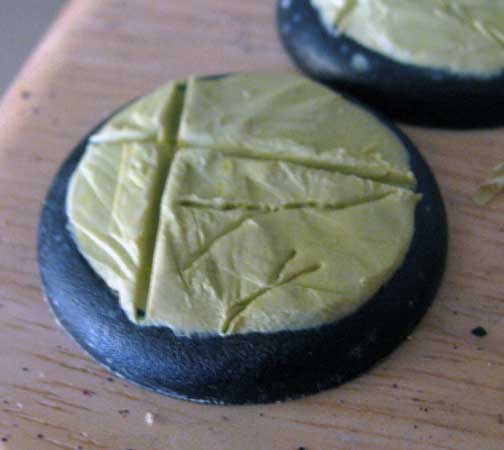
Back to the point having picked up some two part epoxy I spent the weekend sculpting bases for my Incursion models. After looking at all the squares on the gameboard I decided to stick with a simple tile pattern. After mixing up a blob of the epoxy I pressed and smoothed it onto the bases. To eliminate the finger prints I smoothed them over with a bit of water, setting them aside to set up for a minute or two I dug out my scuplting kit. The tools I have are labeled for wax scuplting but they work really great on the epoxy. The key is to keep your tool moist so it doesn't stick and tear (insert life lesson here).

Using the flat edge I carved the basic shape of the tiles into the base. After that I used the flat edge to give some texture to the base. I used a dental pick to add some hairline cracks. After the putty cured I went back in with a blade to add more cracks and chips.

To mount the models I removed the tabs from their feet with a pair of clippers and filed them flat. Using a pin vise I drilled a hole in their feet to insert a brass rod and glue them to the base with Gorilla Super Glue.


Settling up - Trying something new

Boardgames – Over the weekend, I had a chance to play Settlers of Catan with some friends from out of town. I'm slightly embarassed to say this was the first time I've ever played this iconic game. I'm not sure if I held out because of the theme or because I mistakenly thought it was about farming, but having now played the game I can see what the fuss is about.

For those of you who have never played Settlers of Catan is a reasource management style game. You collect cards to build roads and cities which in turn randomly generate reasources. The game ends when a player has 10 victory points which are accquired by having settlements, cities and/or some special event cards.

At first blush the game seems more luck based than anything else as you're hoping someone rolls your number to gain reasources. Many times you'll be sitting on a ton of the same reasource, which you can trade to other players for what you need. The bartering system is interesting and adds a layer of strategy to the game. 

I'm looking forward to playing more games of Settlers and will probably pick this one up for our family game night.

Incursion, first impressions

Incursion – This is one of those games that had been on my radar for a long time, but the 2-player limitation always prevented me from picking it up. Last year Grindhouse Games had a sale on the box set for $15, a price that could be justified even if I only played the game once in a while. Once the box arrived I was really impressed with the quality of the card board components and the art is amazing (Keith Lowe is the artist that does the art for MERCS). Reading through the rules it seemed pretty simple and quick to play.

Players alternate turns based on a bidding system which also regulates the number of actions they can preform during a turn. Within the main rulebook are multiple scenarios that provide plenty of replayability. Combined with the ability to chose a different force each time you'll be able to get plenty of use out of the basic box. There is an expansion available for players that need more models and missions.

I did receive the German model set and hope to get them assembled soon. While the models are really cool and well detailed they aren't necessary to enjoy the game. They are a bit pricey if you can't find them on sale but, I feel like they will add to the overall experience and I've seen a few examples online of 3-dimensional boards that bring the game to a whole 'nother level. 

Essentially this plays very similar to a Weird War II version of Space Hulk, with the option of keeping the cost down by leaving the models out of the core game box. 

Zooleretto ... what does it mean

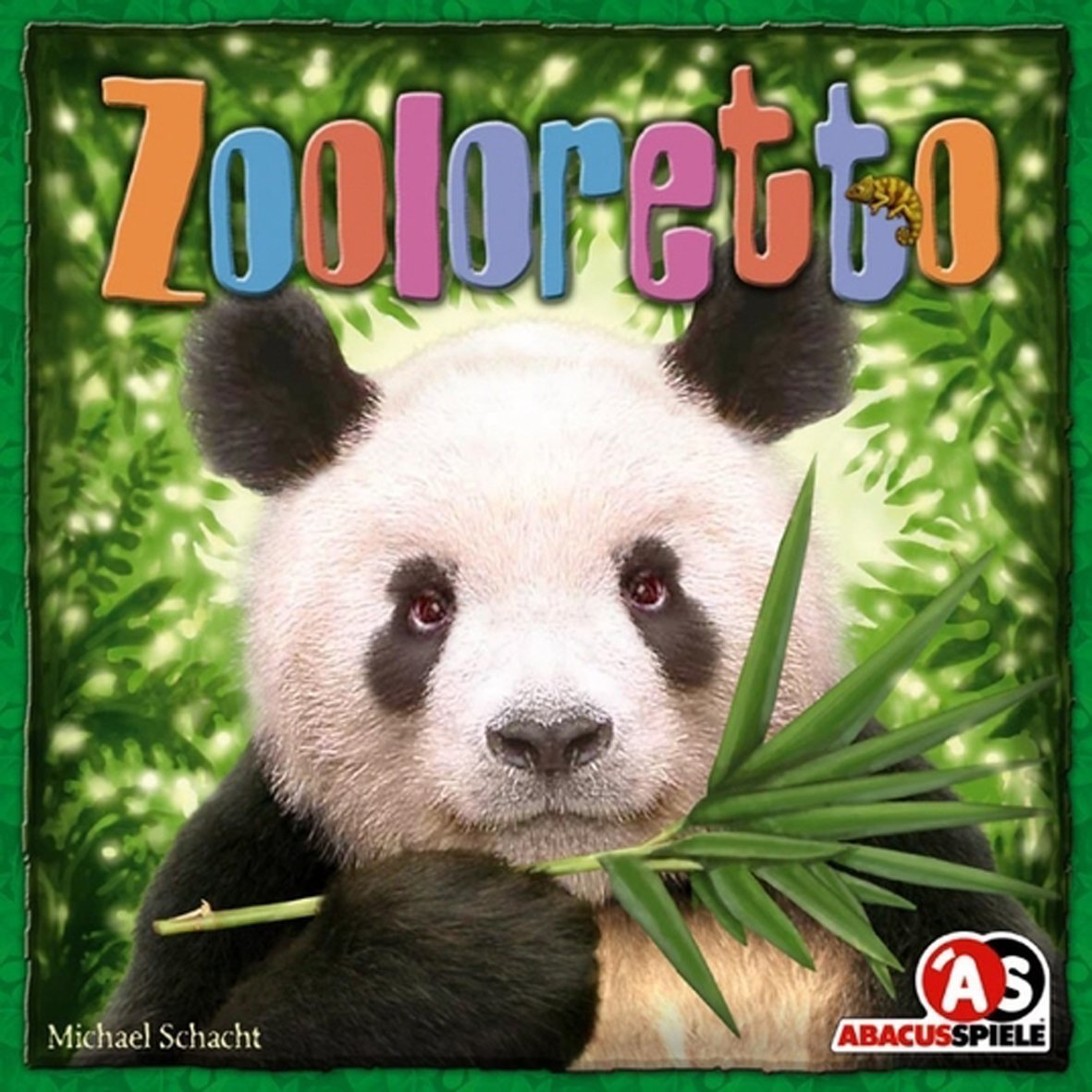
Board Game Review – Last Christmas my daughter received Zooleretto as a gift. For some reason it sat on the shelf unplayed until recently. The premise of the game is each player is building a zoo and the goal is to finish your zoo before the other players. Basically it's a worker placement type of game with a few interesting twists.

To start all the tiles are placed in the center of the table (subtract all animals of a type for smaller games) and players take turns drawing tiles and placing them face up on the delivery trucks. During a players turn they can do one of the following: draw a tile, spend coins to remodel or buy animals, or take a truck. Once a player takes a truck they can not do anything else until all the trucks are taken and than play continues as before. 

Once all the tiles are gone players total up their score based on how complete their zoo is and the winner is determined by the highest point total.

Sounds really simple right?

The basic mechanics of this game could be re-skinned with any type of theme and they'd still work just fine and provide an entertainingly simple yet challenging game. What makes this an entertaining family game is the colorful zoo animal art and universally appealing nature of cute animals to children of most any age.

We've played several times with various numbers of players and each time the game is very different. The first few times my daughter focused on collecting the animals she liked rather than what would fill her zoo and therefore lost. Soon she figured out the basic strategy and can be really hard to beat. Zooleretto has become her go to game when friends are over.

If you're looking for a family-friendly game that involves a bit of strategy I recommend picking this one up.

Review – Call of Cthulhu Card Game

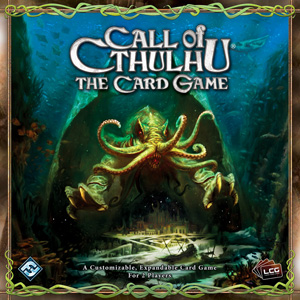
Recently I had a chance to sit down and give the Call of Cthulhu Card Game a test drive (well not really a test drive since I own it, just got around to reading the rules and playing it). This is a Fantasy Flight game so of course there's some cool cardboard bits and some amazing plastic statues. The core game comes with everything you need to play and try out the various combinations of the seven factions.

Opening the box we find:

155 Customizable Deck Cards (split between each of the seven factions)

10 Story Cards

24 double sided Story markers (One side for wounds and the other side for success)

6 Plastic Cthulhu Domain Markers

1 Game Board

1 Rulebook

The rulebook seems to be a bit daunting at first but once you get through the 12 pages of rules it becomes easier to just explain how things work to another play. Each player choses two of the factions to build a deck, some combinations work better than others as a player can't have evil and heroic characters in play at the same time. I really liked pairing cthulhu with the syndicate, but any combination can work well. You start the game with 8 cards and play three of them as resources, each turn you can then play another resource. The system is similar to mana in magic, but rather than counting on drawing a specific card you can play any card as a resource. This leads to some hard decisions, as once a card is played as a resource you can't use it for anything else. After playing your resource you drain it by placing the nifty statue on the cards. The odd thing here is regardless of how many cards are under the domain you can only drain it once. For example I want to play a green card that costs 2, but my only green resource is on the domain in which I have 5 resources (cards), if I drain it I don't get to do anything with those left over resources. I like this as it forces you to plan ahead as well as the fact that some cards give an additional effect if you overpay for them.

After you've played your characters and whatnot you move into the story portion of the game. In order to win you must collect three story cards. During a players turn they can dedicate characters to a story and your opponent than can respond by doing the same. Each story goes through several phases and a player wins the phase by having more cards with the appropriate symbol on it for a phase. If you get to the final phase without your characters going crazy or dying you gain a token for the story. Once you have 5 tokens on a story you win it and have the option of triggering the event on the story card. Your opponent than gets their turn and does the same the response mechanic is interesting as it's hard to judge what you opponent will do because if they don't contest you, you'll gain two tokens, but if you totally dedicate yourself they can do the same.

I really like the game, my only real gripe is that it only works for two players, trying to modify it for multiplayer games would be a nightmare, so the amount of play it will see is fairly limited. The game does play fast enough to act as a filler between larger games so that's a bonus. The fact that it's a living card game is also cool as you know exactly what you get when you buy the game and/or expansion packs. The downside is even though it is a "living" card game some of the earlier release are very difficult to find and there isn't a concrete date set for reprints.

After doing some research it appears that there is a "official" format for events and deck building which limits you to three of any card. The sets only come with one of any card so to play competitively you'd need to buy three of any core set or expansion. That said I've never seen the game played competitively anywhere and don't find myself drawn to that aspect.

To some it up, this is a good game to bust out with a friend and have some fun. It's fairly quick to learn, yet has a depth of tactics to make it a challenging game. The components are great, the art has a pulp feel and it fits into the mythos without taking several hours to set up and play.



Product Review – Castle Ravenloft Board Game

I was recently able to try Castle Ravenloft. My first thoughts looking at the box was oh look Wizards made their own Hero Quest Game. I don't play D&D but the guys I tested this with do, and they informed me it's a really simplified version of the 4th edition rules. 

The components are very nice, in the box you get a ton of plastic miniatures, heavy card stock: dungeon tiles, character cards, tokens, and markers. The box also includes a rules manual, and adventure guide. There are also several decks of cards. My only issue with the components is the fact that the "organizer" forces you to pile everything together and there's not separators for the card decks. I've seen several good solutions on boardgamegeek.com, but it would be nice if the box came with a better way to organize all the parts. As it stands you either spend a significant amount of time sorting prior to play or interrupt the game to dig for the needed piece, marker or token.

Game play is really easy and intuitive. Each player has a card that lists the order of play. The phases consist of Hero Phase: fight, move etc; Exploration Phase: place new tile, encounter etc; Villian Phase: monters, traps etc drawn by the active player move, fight etc.

Aside from what is dictated by the adventure guide, everything that happens in the game is determined by on of several decks of cards. This means that no adventure will ever be exactly the same. The dungeon is also drawn randomly from a stack of tiles so it will also rarely be exactly the same.

Combat is simply a matter of rolling a D20, adding the total to your modifier and comparing it to the AC of whatever your attacking. You then apply the damage and if the damage exceeds the wounds you destroy the monster and draw a treasure.

This is a really fun game and I can see it popping out as a filler between larger games or playing several adventures over the course of an evening. The components are very nice and of a good quality and I imagine that expansions will be made in the future. Although because of the random generation of events it will probably take a while to grow bored with what you get in the box.

Board Game Night

Saturday we had some friends over to try out some of the new games we received for Christmas. To start out the night we played Sorry Sliders. This is a really fun dexterity game that is similar to shuffleboard. The neat thing about it is the variety of boards. Each center board has it's own rules and scoring system. Mt personal favorite is the red board, "Danger Dots," if your piece touches one of the exclamation points on the board it's removed from play. Scoring is done with a separate tracker which matches up with the slider. Just like in Sorry the goal is to get your pieces to "Home" by an exact count. Everyone seemed to enjoy the game an although it's set up for 4 players you could easily create teams for larger groups.

Next up on the list is a game called Smart Ass. This one has a very simple board that tracks a players success. After answering a question correctly the player roles a 12-sided die marked with 1, 2, 3, and 4 to see how far you move. Each turn one player reads clues and the rest of the players blurt of an answer, if you answer wrong you cannot answer again. The clues are fun and this makes a fun party game. My only complaint is the board is to short and it's fairly easy for one player to quickly run away with the game. Overall fun but not the best game design.

The third game we played is Urban Myth. I had high hopes for this game as I'm a huge fan of urban legends. The gameplay is a bit confusing. Each player has a card that says truth on one side, myth on the other. One player reads a clue and the rest the the players secretly flip their card to say truth or myth. Players that get it right advance one space around the board, the reader advance one space for each player that got it wrong. That part is simple, it gets weird when it comes to scoring. If a player is on a square that matches the category of the clue and they correctly answer the question they get the card. Each card has a letter on the back and you when the game by collecting cards to spell TRUE or MYTH. While the game is fun and lets people that are terrible at trivia have a 50/50 shot of getting it right the scoring is very random and doesn't have much strategy. Fun party game that could easily benefit from some house rules or a dice to select categories. 

We wrapped up the evening with Carcassonne: The Discovery. Allegedly this is a simplified version of Carcassonne geared to younger players. I wasn't a big fan of this game as the simplification takes a lot of the fun and strategy out of the game. Each player has 5 meeples one that is used one the score board and the others are used to denote Brigands, Explorers and Privateers. The scoring for the game is slightly confusing as its based on the geography of the board rather than cities like the original. I think the combination of playing it late in the night for the first time and the oversimplified rules led to us not enjoying this game as much. We'll give it another shot, but right now I think I prefer the original.